Louisville winters can turn hard in a hurry. One overnight freeze can split a pipe in a unit nobody is watching, and a burst pipe is one of the most expensive surprises a rental owner can get. The good news is that most of the risk is handled with an hour or two of preparation in October or November.
Winter is our busiest maintenance season. From December 2025 through February 2026, we logged 2,877 maintenance requests across the homes we manage, and plumbing (432) and heating and cooling (373) were the two largest categories. Much of that is preventable with the steps below.
Here is the checklist we walk through on the rentals we manage. It is general information, not professional plumbing or insurance advice, so check with your plumber and your insurance agent about your specific property.
Vacant units need the most attention
An occupied home usually has someone who notices a cold room or a drip. A vacant unit does not.
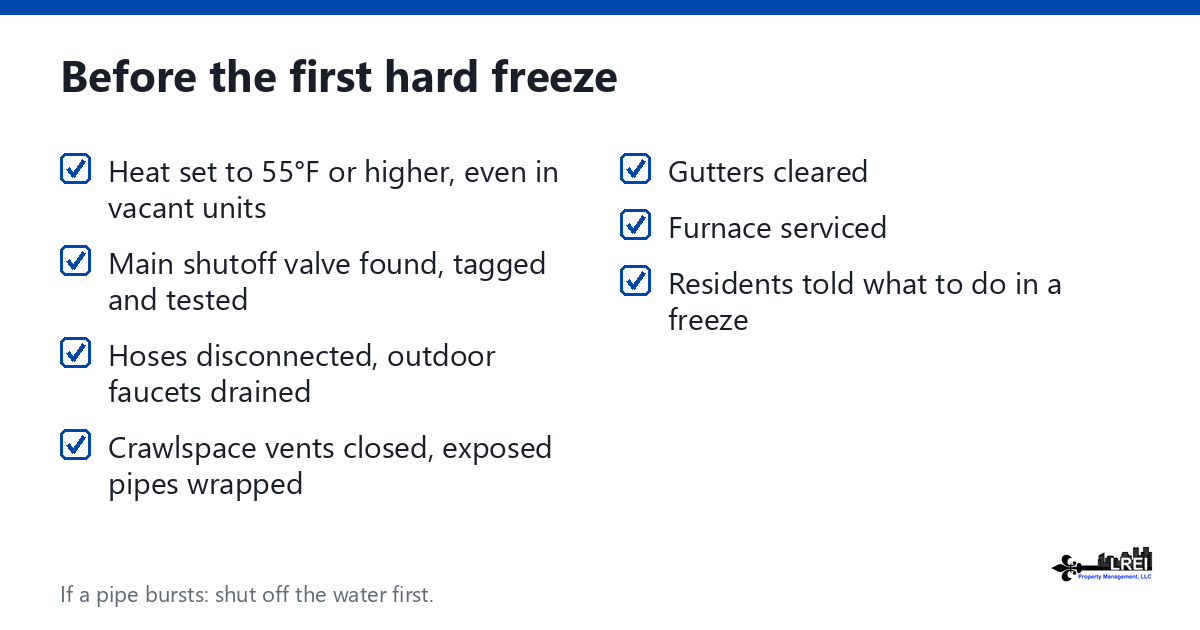
- Keep the heat on. Many plumbers recommend never letting a vacant home drop below about 55°F. Turning the heat off to save money is a common and costly mistake.
- Check in regularly. Walk the unit after any hard freeze, looking for drips, stains and cold spots.
- Ask about draining the lines. If a unit will sit empty for a long stretch, a plumber can tell you whether shutting off the main and draining the system makes sense for your plumbing.
Know where the shutoff valve is
If a pipe bursts, the first job is stopping the water. The main shutoff is often near the water heater, in a basement, or in a utility closet. Find it now, tag it, and turn it once to make sure it actually works. A valve that is stuck in October is a much bigger problem in January.
Louisville Water says it gets calls every year during extreme cold from customers whose internal lines have frozen or burst, and it gives out free waterproof tags for shutoff valves at its downtown office on Third Street. Its advice lines up with the checklist here: wrap exposed pipes, cover crawlspace vents, keep the garage door shut on slab homes, and run a small stream of cold water during extreme cold.
Outside the house
- Disconnect garden hoses and drain exterior hose bibs (outdoor faucets) before freezing weather arrives. A hose left attached can trap water that freezes and damages the pipe behind the wall.
- Clean the gutters so meltwater and ice do not back up toward the roofline and walls.
- Check that downspouts carry water away from the foundation.
Crawlspaces, basements and exposed pipes
- Close or cover crawlspace vents for the winter and repair gaps that let cold air in.
- Wrap exposed pipes in unheated spaces with foam insulation from a hardware store.
- Look closely at pipes along exterior walls, in garages and under sinks, which are common trouble spots.
- Repair drafty rim joists, broken basement windows and missing access panels.
Furnace service
A furnace that quits on the coldest night of the year is both a comfort problem and a frozen-pipe problem. Have the system serviced and change the filter before the cold arrives. Do not wait for the first no-heat call.
What to tell your residents
Clear communication prevents a lot of damage. Send residents a short winter notice that covers:
- Keep the heat on, even when traveling.
- On very cold nights, open cabinet doors under sinks and let a faucet drip slightly.
- Disconnect hoses from outdoor faucets.
- Where the main shutoff is, and how to reach you or your manager after hours.
- Report leaks, stains or no-heat issues right away. Early reports are cheap; late ones are not.
Check your lease and local rules about what notices you should give and how.
If a pipe bursts
- Shut off the water at the main valve.
- If water is near outlets or fixtures, stay clear, and turn off power only if you can do it safely.
- Call a licensed plumber.
- Take photos and video for your insurance claim, and contact your insurance company.
- Start drying the space quickly, because lingering moisture leads to mold.
How we handle it
On our managed homes, maintenance requests are tracked in PropertyMeld, and our sister company, Reliabuilt Contracting, handles repairs in-house. That means a leak report becomes a time-stamped work order rather than a lost voicemail. Owners see the results in their monthly statements and the online owner portal.
Preparation does not guarantee a freeze-proof winter, but it stacks the odds in your favor.
Own a rental in Louisville? Request a free rental analysis at louisvillepropertymanagement.com/owners and our team will follow up.
LREI Property Management LLC has managed rental homes in Louisville since 2017.