
When a rental home gets a new roof, a new furnace or a new electrical panel, three things usually happen: the work gets done, the invoice gets paid, and the work order gets closed. One thing usually does not: nobody tells the insurance company. This post explains why that matters to you as an owner, and what we now do about it. It is general information, not insurance advice. Your agent can tell you exactly how your policy works.
What we found on our own homes
Our owner, Clay Smith, owns rental homes himself, and this fall we compared his insurance declarations to what we actually knew about each house. Every policy listed a roof that was older than the real one, by 4 to 26 years. Some were Actual Cash Value policies. On that kind of policy, a claim generally pays the depreciated value of the roof the insurer has on record. A new roof was being insured, and could have been paid, as an old one.
No one had done anything wrong. The roofer did the job and was paid. The insurer simply never heard about it.
Why the age of a roof or system matters to your wallet
- Your premium. Many insurers price homes partly on the age of the roof and of major systems like electrical and heating. A newer roof or panel may qualify for a better rate. Ask your agent whether yours does.
- What a claim pays. If your policy pays Actual Cash Value, the age on record can change the check after a storm.
- Proof when you need it. If an adjuster asks when the roof was replaced, you want the date, the invoice and the work order in one place.
- Older-home rules. Some carriers will not renew, or add surcharges, when a roof or panel appears to be past a certain age. An out-of-date record can make a newer home look like a riskier one.
How we keep each home's record current
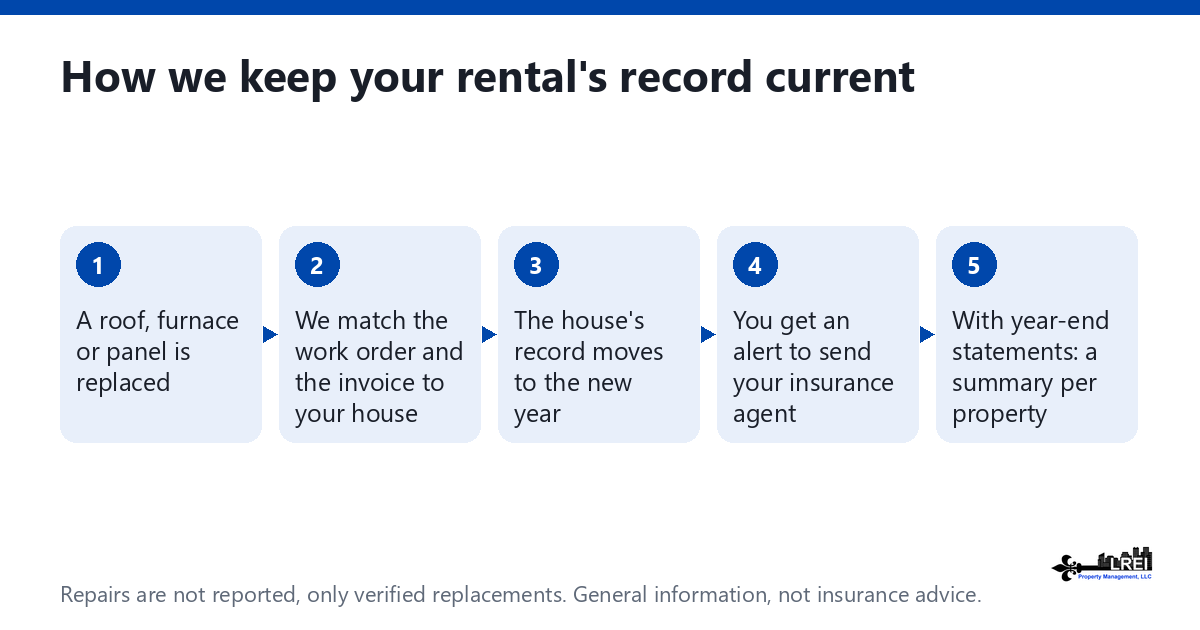
We keep a record for every home we manage that tracks the age of its roof, electrical panel, heating and cooling, and plumbing, and where each of those facts came from. Our software reads the maintenance work orders, contractor jobs and payments that already pass through our office, and picks out the ones that are true replacements:
- Replacements, not repairs. Patching a roof leak does not change the roof's age. A full tear-off and re-shingle does. Only verified replacements update the record.
- Matched to the right house. Every event is tied to the property, not to a typed address.
- Counted once. A roof can show up as a job, an invoice and a payment. It is still one roof.
We use AI for the sorting, reading notes like "new unit installed" or "replaced breaker panel" and deciding what they mean. A person can trace every update back to the invoice behind it.
Owner alerts that can save you money
This is the part that matters to you. When we replace a roof, a furnace, a water heater or an electrical panel on your rental, you will get a short alert you can forward straight to your insurance agent: the property, what was replaced, the date and the invoice. With your year-end statement, you will also get a per-property summary of the insurance-relevant work done during the year, so your renewal conversation starts with current facts.
Whether that lowers your premium depends on your carrier and your policy. It costs you nothing to ask, and you will have the paperwork ready when you do.
What you can do today
- Pull your declarations page. Look for the roof year and the construction or update years listed for your rental.
- Compare it to what you know. If you replaced a roof, panel or HVAC system since the policy was written, send your agent the date and the invoice.
- Ask one question. "Does a newer roof or system change my rate or my claim payout?"
- Keep the record. File the invoice with the policy, not just with your taxes.
Own a rental in Louisville? Request a free rental analysis at louisvillepropertymanagement.com/owners and our team will follow up.
LREI Property Management LLC has managed rental homes in Louisville since 2017.