
A 16x jump in code-enforcement cases doesn't happen by accident. It happens because a city decides to enforce harder — and Louisville Metro made exactly that decision across four overlapping initiatives. Here's what changed, with the receipts.
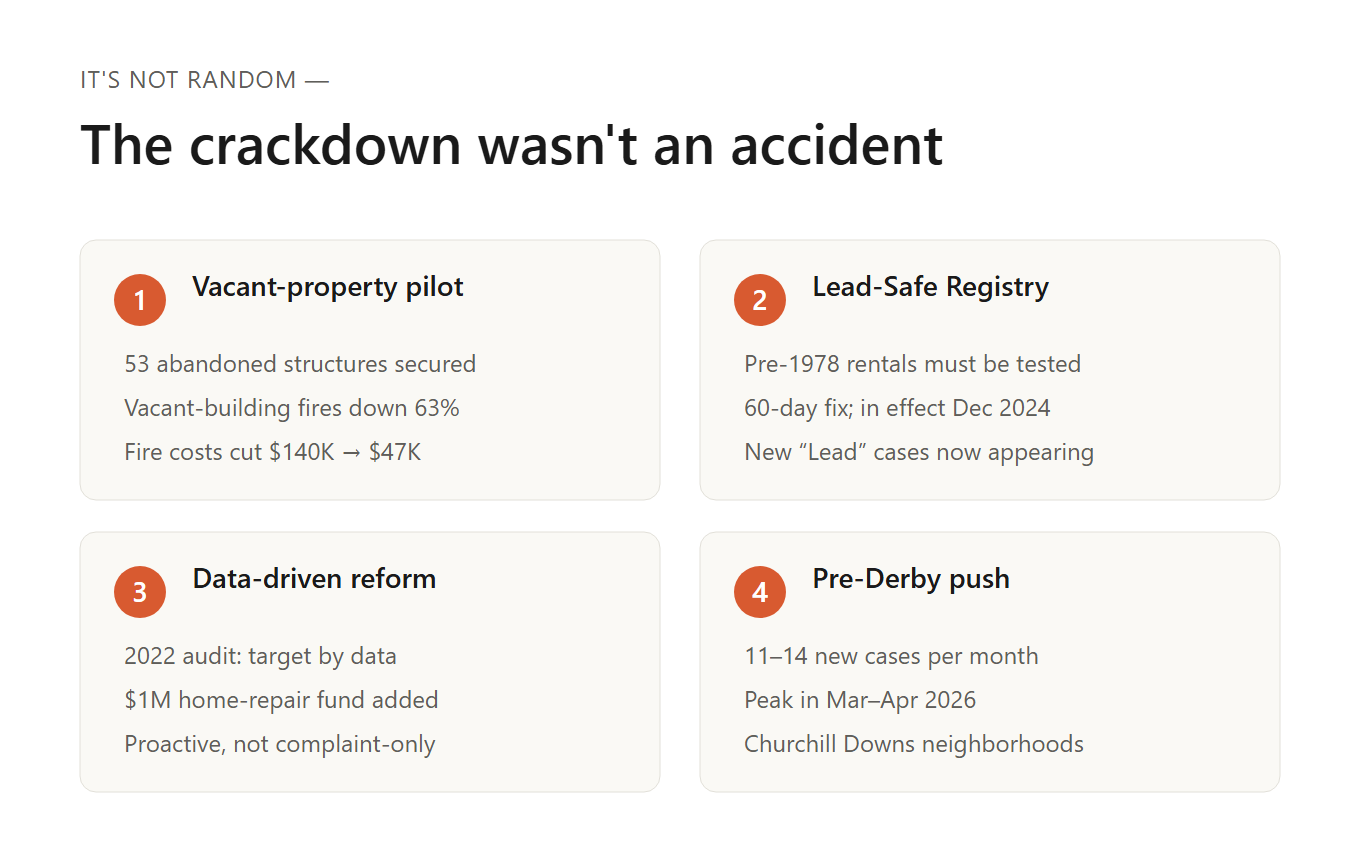
1. The Mayor's Vacant & Abandoned Property pilot. Mayor Craig Greenberg's office stood up a vacant-property enforcement pilot in the Portland and Russell neighborhoods. In its first year (2024–2025), code-enforcement officers and boarding crews identified and secured 53 abandoned structures, producing a 63% drop in vacant-structure fires and cutting fire-related city costs from $140,157 to $47,425 — a 66% reduction. The "clear-boarding" ordinance reached unanimous committee approval in July 2025. This is the enforcement arm getting funded and operationalized. (Spectrum News 1, 7/22/25)
2. The Lead-Safe Housing Registry. Passed in December 2022 and effective December 2024, this ordinance requires owners of pre-1978 rental properties in Jefferson County to get a certified lead-risk assessment, remediate hazards within 60 days, and register the property. The backdrop: a University of Louisville study found nearly 10,000 Louisville children tested with elevated blood-lead levels between 2005 and 2021. This created an entirely new enforcement lane — and it's exactly why "lead" cases are now showing up in investor files for the first time. (LPM, 2/18/25; Kentucky Lantern, 2/26/25)
3. A deliberate shift to data-driven enforcement. After a 2022 racial-equity audit conducted with the national nonprofit Center for Community Progress, Codes & Regulations was advised to "use data and resident input to define enforcement priorities" and to pursue code-lien foreclosures — alongside $1 million in new home-repair assistance. Translation: enforcement became systematic and targeted rather than purely complaint-driven. (Center for Community Progress)
4. The Kentucky Derby push. Our data spiked hardest right before the May 3 Derby — 11 cases in March and 14 in April 2026. The public-facing version of that push was the "Building Our Blocks" initiative in the Lucky Horseshoe neighborhood in the shadow of Churchill Downs, organized by Metro Councilmember Jennifer Chappell, with city departments doing home repairs and inspections. It's framed as beautification — but the enforcement crest landing in the same pre-Derby weeks tells you where the stick was. (WHAS11)
Why this matters to investors
These aren't temporary campaigns — three of the four are permanent ordinances and funded programs. The lead registry alone phases in older rentals on a published schedule through 2027, meaning the enforcement net widens every year regardless of who's in office. If your strategy assumed Louisville's old "complaint-only, slap-on-the-wrist" posture, that assumption is now wrong. The city built machinery, and machinery doesn't take a year off.
Facing a code-enforcement case—or want to stay off the radar entirely?
LREI Property Management tracks Louisville's enforcement queue daily and keeps your rentals registered, compliant, and out of the hearing room. Get ahead of it before the city does.
📧 Email sales@lreillc.com or 📞 call (502) 576-7253.
Sources linked inline above.