
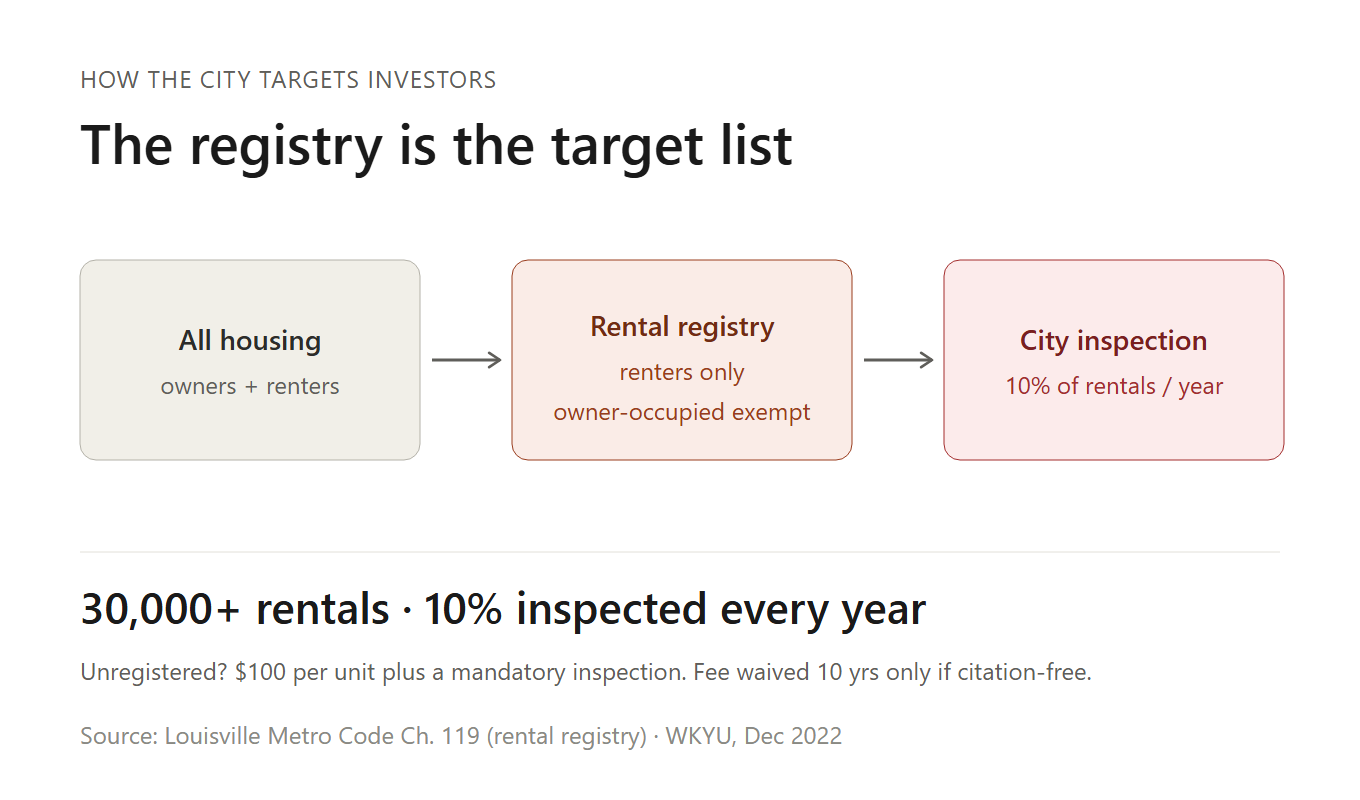
Here's a fact most Louisville investors haven't connected: when you register a rental with the city, you're not just filing paperwork. You're adding your property to a database that, by law, contains only non-owner-occupied property — and that database is wired directly to inspections and citations.
The Rental Registry (Metro Code Chapter 119, passed December 2022). Every long-term rental must register. Owner-occupied homes are exempt. The entire universe of the registry is investor property. And it's not a passive list:
- The city runs proactive inspections — not complaint-driven — across 11 market areas with high renter density, covering roughly 30,000+ properties, inspecting 10% of rental units in those zones every year. (WKYU, 12/16/22)
- Not registering is itself an enforcement trigger: up to $100 per unregistered unit, plus a mandatory code-enforcement inspection. You get inspected either way.
- The fee ($25–$250) is waived for up to 10 years — but only if you stay citation-free. Get cited, lose the waiver. It's a compliance leash, not a courtesy.
Even a landlord on the record — investor Nina Musgrave — warned the inspections "unfairly target compliant landlords." The targeting framing isn't just an investor talking point; it's in the public hearing record.
The Lead-Safe Housing Registry layers a second target list on top. Also rental-only, owner-occupied exempt, it phases in by build year on a fixed schedule: pre-1940 rentals by Nov 30, 2025; 1940–1965 by Nov 30, 2026; 1966–1978 by Nov 30, 2027. The city is advancing its enforcement net one cohort of older rentals at a time. (WAVE3, 12/9/24; WDRB)
The bottom line, stated fairly: The city sells both registries as tenant protection — habitability and child lead safety — and that's a legitimate goal. But the structure is unambiguous: these registries exist only for non-owner-occupied property, they build a searchable roster of it, and they connect that roster straight to inspections and fines. Owner-occupants are exempt from all of it. Whatever the stated intent, the mechanism singles out investors by design.
Why this matters to investors
Registration isn't optional, and non-compliance doesn't keep you off the radar — it puts you on it, with a fine and a mandatory inspection. The smart move is to treat registration as the front door to a system you're now permanently inside: register on time, protect the 10-year fee waiver by staying citation-free, and get ahead of the lead-testing deadline for your build-year cohort before the city's phase reaches you. The investors who thrive under this regime are the ones who treat compliance as a managed process — not a surprise.
The city created a list that, by law, contains only rental property — then committed to proactively inspecting 10% of it every year in the neighborhoods with the most renters. Registration isn't paperwork; it's the targeting database.
Facing a code-enforcement case—or want to stay off the radar entirely?
LREI Property Management tracks Louisville's enforcement queue daily and keeps your rentals registered, compliant, and out of the hearing room. Get ahead of it before the city does.
📧 Email sales@lreillc.com or 📞 call (502) 576-7253.
Sources linked inline above.